
Marie Curie
Quotes & Wisdom
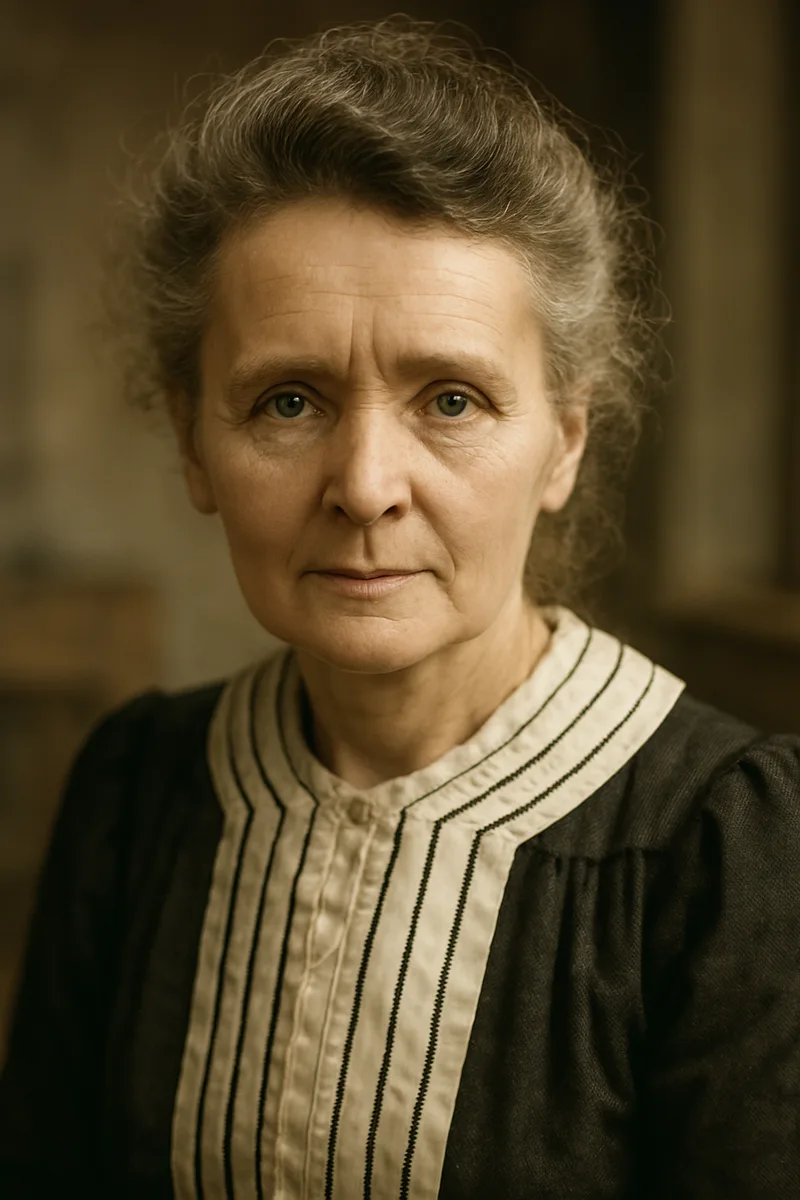
Marie Curie: The Pioneer Who Illuminated the Invisible
Marie Curie was the first woman to win a Nobel Prize, the first person to win two Nobel Prizes in different sciences, and the scientist who brought the concept of radioactivity from obscurity to the center of modern physics and medicine. Born Maria Sklodowska in Warsaw under Russian occupation, she emigrated to Paris with little money and enormous ambition, earned two degrees at the Sorbonne, and with her husband Pierre discovered the elements polonium and radium. Her work fundamentally altered humanity's understanding of the atom and laid the groundwork for everything from cancer treatment to nuclear energy - achievements that ultimately cost her life, as decades of radiation exposure destroyed her health.
Context & Background
Maria Sklodowska was born on November 7, 1867, in Warsaw, Poland, then under the oppressive rule of the Russian Empire. The Russians had suppressed Polish language and culture, and Marie grew up in an atmosphere of quiet, determined resistance. Her father, Wladyslaw Sklodowski, was a mathematics and physics teacher, and her mother, Bronislawa, ran a prestigious boarding school until tuberculosis forced her to resign. Both parents instilled in their children a reverence for education as the path to both personal fulfillment and national liberation.
Marie was the youngest of five children and the brightest. She had a prodigious memory - she could recite entire passages after a single reading - and she excelled in every subject. But in Russian-controlled Poland, universities were closed to women. Marie and her older sister Bronya made a pact: Marie would work as a governess to fund Bronya's medical studies in Paris, and Bronya would then support Marie's education. For five years, Marie taught children in rural Poland, studying science on her own at night from borrowed textbooks.
In 1891, at age twenty-four, Marie finally arrived in Paris and enrolled at the Sorbonne. She lived in a tiny attic room in the Latin Quarter, surviving on bread, chocolate, and tea because she could not afford both food and books - and she chose books. She earned her degree in physics in 1893, finishing first in her class, and a degree in mathematics the following year. In 1894, she met Pierre Curie, a brilliant physicist who shared her passion for science. They married in 1895 in a simple ceremony - Marie wore a dark blue dress that she later used as a laboratory outfit.
Marie Curie's doctoral research began with a puzzling observation by Henri Becquerel, who had discovered that uranium salts emitted mysterious rays. Marie decided to investigate these rays systematically, and she made a crucial early discovery: the intensity of the radiation was proportional to the amount of uranium present and was not affected by chemical combinations or physical conditions. This meant the radiation was an atomic property - a revolutionary insight that pointed toward the internal structure of the atom itself.
Working in a converted shed that was little more than a leaky warehouse - with no proper ventilation, no funding, and a dirt floor - Marie and Pierre Curie began processing enormous quantities of pitchblende ore. Marie developed methods to isolate radioactive elements, and in 1898 they announced the discovery of two new elements: polonium, named for Marie's beloved homeland, and radium. To prove radium's existence to skeptical chemists, Marie spent four years processing eight tons of pitchblende by hand, boiling and filtering and distilling, to isolate one-tenth of a gram of pure radium chloride.
In 1903, Marie and Pierre shared the Nobel Prize in Physics with Becquerel. Marie was initially not included in the nomination - the committee planned to honor only Pierre and Becquerel - until Pierre insisted that Marie's contribution be recognized. She was the first woman to receive a Nobel Prize, though the significance of this was largely overlooked at the time.
Pierre Curie's death in 1906 - he was struck by a horse-drawn cart on a rain-slicked Paris street - left Marie devastated and alone with two young daughters. The Sorbonne offered her Pierre's chair, making her the first woman to teach at the university in its 650-year history. She threw herself into work with an intensity that alarmed even her closest friends.
In 1911, she won a second Nobel Prize, this time in Chemistry, for her isolation of pure radium and her determination of its atomic weight. No one before her had won Nobel Prizes in two different scientific disciplines - a feat that has been matched only by Linus Pauling since. But the same year brought public scandal: her relationship with the married physicist Paul Langevin was exposed by the French press, and she was subjected to vicious xenophobic and misogynistic attacks. Newspapers that had celebrated her discoveries now called her a foreign homewrecker. The Nobel Committee even suggested she not come to Stockholm to accept the prize. Marie went anyway.
During World War I, she developed mobile X-ray units - nicknamed "petites Curies" - and drove them to the front lines herself, training military doctors in radiological techniques. She and her teenage daughter Irene helped save countless soldiers' lives by enabling surgeons to locate bullets and shrapnel. The French military establishment initially resisted taking direction from a woman; Marie overcame this with characteristic persistence.
Marie Curie kept radium samples in her desk drawer and carried test tubes of radioactive isotopes in her pockets. Her personal belongings - including her laboratory notebooks - remain so contaminated with radium-226 that they are stored in lead-lined boxes at the Bibliotheque nationale de France, and anyone wishing to view them must sign a liability waiver and wear protective clothing. The notebooks will remain radioactive for another 1,500 years.
She was extraordinarily modest about her achievements, deflecting praise toward the work itself rather than her role in it. She refused to patent the radium-isolation process, believing that scientific discoveries belonged to humanity, not individuals - a decision that cost her a fortune but cemented her legacy as a scientist of uncommon integrity. She died on July 4, 1934, of aplastic anemia caused by years of radiation exposure. In 1995, she became the first woman to be entombed on her own merits in the Pantheon in Paris, the resting place of France's greatest citizens.