
Leonardo da Vinci
Quotes & Wisdom
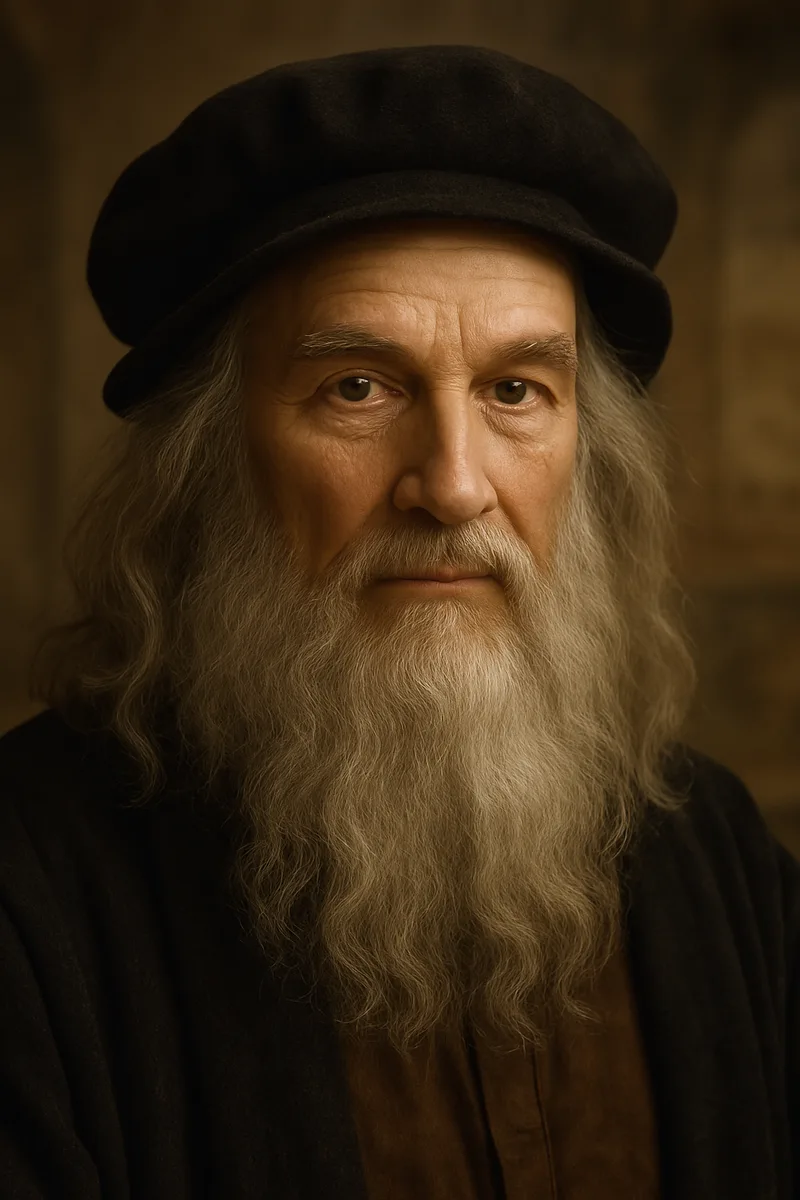
Leonardo da Vinci: The Mind That Refused Every Boundary
Leonardo da Vinci was not merely a genius in one domain - he was a genius in every domain he touched. Painter, sculptor, architect, engineer, anatomist, botanist, musician, cartographer, and inventor, he moved between disciplines with a fluency that has never been equaled. The Mona Lisa and The Last Supper stand among humanity's greatest artistic achievements, yet Leonardo considered painting only one expression of a deeper project: understanding the fundamental workings of nature through direct observation. His notebooks - seven thousand pages of drawings, diagrams, and mirror-script text - reveal a mind in perpetual motion, leaping from the mechanics of bird flight to the geometry of flowing water to the anatomy of the human heart. Leonardo's words carry the conviction that curiosity is the highest virtue and that seeing clearly is the beginning of all knowledge.
Context & Background
Born on April 15, 1452, in the Tuscan hill town of Vinci, Leonardo was the illegitimate son of Ser Piero da Vinci, a prosperous notary, and Caterina, a peasant woman. His illegitimacy barred him from attending university or entering most professions - a social exclusion that paradoxically freed him from conventional education and allowed his self-directed curiosity to flourish without constraint.
Around 1466, Leonardo was apprenticed to Andrea del Verrocchio, one of Florence's leading artists, in whose workshop he learned painting, sculpture, metalworking, and engineering. Florence under Lorenzo de' Medici was the intellectual capital of Europe - a city where art, science, philosophy, and commerce intermingled with explosive creativity. The young Leonardo absorbed everything, but he was not a typical Florentine humanist. Where others studied ancient texts, Leonardo studied nature directly. 'Experience,' he wrote, 'is the mother of all knowledge.'
His early masterwork, the unfinished Adoration of the Magi, demonstrated technical ambition that outstripped any commission. Leonardo was already more interested in solving problems than in finishing projects - a pattern that would define his career and drive his patrons to frustration.
Leonardo approached painting not as decoration but as investigation. He studied light, shadow, perspective, anatomy, and emotion with scientific precision, seeking to reproduce not just the appearance of things but their underlying reality. His technique of sfumato - the subtle blending of tones without visible brushstrokes - gave his paintings an atmospheric quality that no contemporary could match.
The Last Supper, painted between 1495 and 1498 on the wall of the Santa Maria delle Grazie refectory in Milan, captured a single dramatic moment - Christ's announcement that one of his disciples will betray him - with psychological insight that was centuries ahead of its time. Each figure reacts differently, creating a composition of extraordinary emotional complexity.
The Mona Lisa, worked on intermittently from around 1503, became the most famous painting in the world - though Leonardo never delivered it to any patron, carrying it with him until his death. Its enigmatic smile, achieved through layers of translucent glazes applied over years, embodies Leonardo's belief that the greatest art captures the moment between one expression and the next.
Leonardo's notebooks are among the most remarkable documents in human intellectual history. Written in his characteristic mirror script (left-handed, right to left), they contain studies in anatomy, hydraulics, optics, geology, botany, aeronautics, and mechanical engineering, alongside sketches for paintings, architectural plans, and philosophical observations.
His anatomical drawings, based on the dissection of over thirty human bodies, were the most accurate produced before the modern era. He correctly described the heart's four chambers, observed the effects of arterial hardening, and produced drawings of muscles, bones, and organs that would not be surpassed for three centuries.
His engineering designs included flying machines, armored vehicles, concentrated solar power, a calculator, and a rudimentary theory of plate tectonics. Most were never built in his lifetime, but modern reconstructions have demonstrated that many would have worked. Leonardo's mind operated at a scale and speed that his era's technology simply could not match.
Leonardo spent his career moving between powerful patrons. He served Ludovico Sforza in Milan, Cesare Borgia as military engineer, the Florentine Republic, Pope Leo X in Rome, and finally King Francis I of France - who gave him the Chateau of Clos Luce near Amboise and, according to legend, held him in his arms as he died on May 2, 1519.
His relationship with Michelangelo was one of the great rivalries of the Renaissance. The two men despised each other - Michelangelo was younger, more focused, and contemptuous of Leonardo's habit of leaving works unfinished. Yet together they pushed the boundaries of what art could achieve.
Leonardo was a vegetarian who bought caged birds at market in order to set them free. He was left-handed, famously handsome in his youth, and known for his physical strength. He dressed flamboyantly in an era when artists were considered craftsmen, not celebrities.
His habit of leaving works unfinished was not laziness but a consequence of his insatiable curiosity - each project opened new questions that pulled him in fresh directions. He left perhaps fifteen completed paintings but thousands of pages of notes that reveal the scope of a mind that saw connections everywhere. For Leonardo, there was no boundary between art and science, observation and imagination, the human body and the body of the earth. Everything was connected, and understanding one thing meant understanding everything.