
Hans Christian Andersen
Quotes & Wisdom
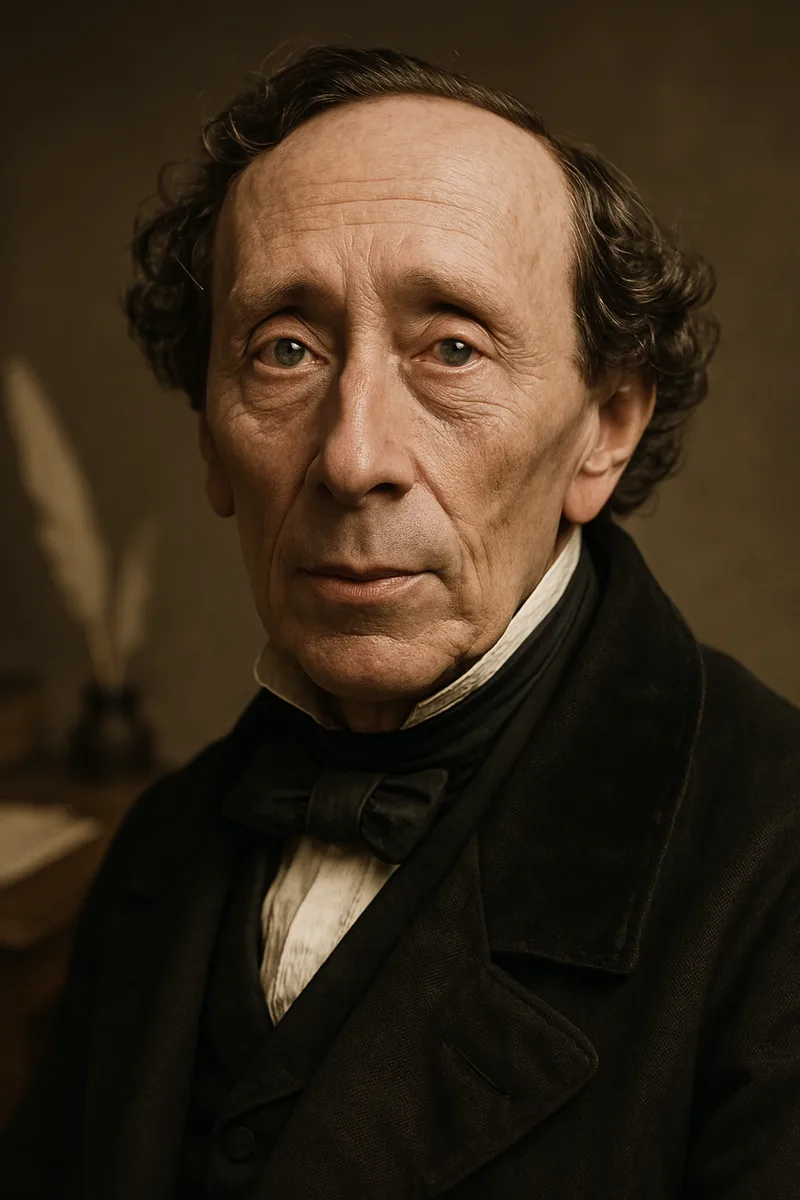
Hans Christian Andersen: The Outcast Who Gave the World Its Fairy Tales
Hans Christian Andersen transformed personal anguish into stories that have enchanted every generation since. Born into poverty in Odense, Denmark, he became the most widely translated Danish author in history. His fairy tales - The Ugly Duckling, The Little Mermaid, The Emperor's New Clothes - are not sugary fantasies but unflinching explorations of loneliness, longing, and the desperate need to belong. Andersen drew from his own experience of being the perpetual outsider - too tall, too awkward, too sensitive for the world he inhabited. His genius lay in making that universal pain beautiful, in showing that the soul's deepest wounds can become its greatest art. His words carry the weight of someone who knew both suffering and transcendence firsthand.
Context & Background
Hans Christian Andersen was born on April 2, 1805, in Odense, Denmark, into circumstances that would have crushed a less determined spirit. His father was a struggling shoemaker who filled the boy's head with stories and built him a puppet theater. His mother was a washerwoman who eventually turned to alcohol. The family lived in a single room.
When his father died in 1816, eleven-year-old Hans was left to navigate a world that had little use for a gangly, dreamy child with an odd singing voice and theatrical ambitions. At fourteen, he left Odense for Copenhagen with nothing but a small bundle of clothes and an unshakable conviction that he was destined for greatness. 'First you must endure hardship,' he later wrote, 'then comes the greatness.'
Copenhagen was brutal. Andersen tried acting, singing, and ballet - failing at each. What saved him was the patronage of Jonas Collin, a director of the Royal Danish Theatre, who recognized something in the ungainly teenager and arranged for his education. The school years were miserable - Andersen was older than his classmates, mocked for his appearance, and tormented by a headmaster who seemed to take pleasure in humiliating him. These experiences of exclusion and cruelty would fuel his greatest works.
When Andersen published his first fairy tales in 1835, he invented a new literary form. Earlier folk tales, collected by the Brothers Grimm and others, were transcribed from oral tradition. Andersen created original stories written in the spoken language of children - deceptively simple prose that concealed sophisticated emotional architecture.
The Ugly Duckling is autobiography disguised as fable. The Little Mermaid explores the agony of loving someone who cannot love you back. The Emperor's New Clothes exposes the absurdity of social pretension. The Snow Queen maps the geography of frozen hearts. Each story operates on multiple levels - entertaining children while devastating adults who recognize the truths beneath the surface.
Andersen published 156 fairy tales over his lifetime, and they were translated into more languages than almost any other literary work. He wrote for what he called 'the child in the adult' - that vulnerable part of every person that remembers what it felt like to be small in a large, indifferent world.
Andersen spent much of his adult life traveling across Europe, and his journeys profoundly shaped his writing. He visited Italy, Germany, Spain, Portugal, Turkey, and England, always carrying notebooks that he filled with sketches, observations, and story ideas. Travel was both escape and inspiration - a way to flee the social constraints of small Copenhagen and to feed an imagination that required constant new material.
His travel books were bestsellers in their time, and his friendships with major European figures - Charles Dickens, Victor Hugo, Alexandre Dumas - gave him the recognition he craved. His famous visit to Dickens in 1857, however, became legendary for the wrong reasons: Andersen overstayed his welcome by several weeks, prompting Dickens to post a note in the guest room reading 'Hans Andersen slept in this room for five weeks - which seemed to the family ages.'
Andersen never married and never found lasting romantic fulfillment. He fell in love repeatedly and painfully - with the singer Jenny Lind (who called him 'brother'), with the dancer Louise Collin, and, scholars now believe, with several men including Edvard Collin and the Hereditary Grand Duke of Saxe-Weimar-Eisenach. His diaries reveal a man tormented by desire and loneliness, recording his anguish in coded language.
This emotional hunger permeates his stories. The Little Mermaid gives up her voice - her identity - for love that is never returned. The Steadfast Tin Soldier loves the paper ballerina from across an impossible distance. The Little Match Girl freezes to death dreaming of warmth she will never feel. Andersen's fairy tales endure because they articulate the universal experience of wanting more than life seems willing to give.
Andersen was a compulsive paper-cutter, creating elaborate silhouettes and collages that he gave as gifts. These intricate artworks - now preserved in museums - reveal the same imaginative precision found in his prose. He was also deeply superstitious, carrying a length of rope in his luggage in case of hotel fires and leaving notes by his bedside reading 'I only appear to be dead' in case he was accidentally buried alive.
He was a tireless self-promoter who understood the power of celebrity long before the modern era. He cultivated relationships with royalty, befriended the famous, and carefully managed his public image. Yet beneath the social climbing was genuine vulnerability. When he received his first copies of a new book, he would pace his room in anxiety, convinced that this time the critics would destroy him. That tension between ambition and fragility made Andersen who he was - and made his fairy tales resonate with the tender, unprotected part of every reader.