
George Orwell
Quotes & Wisdom
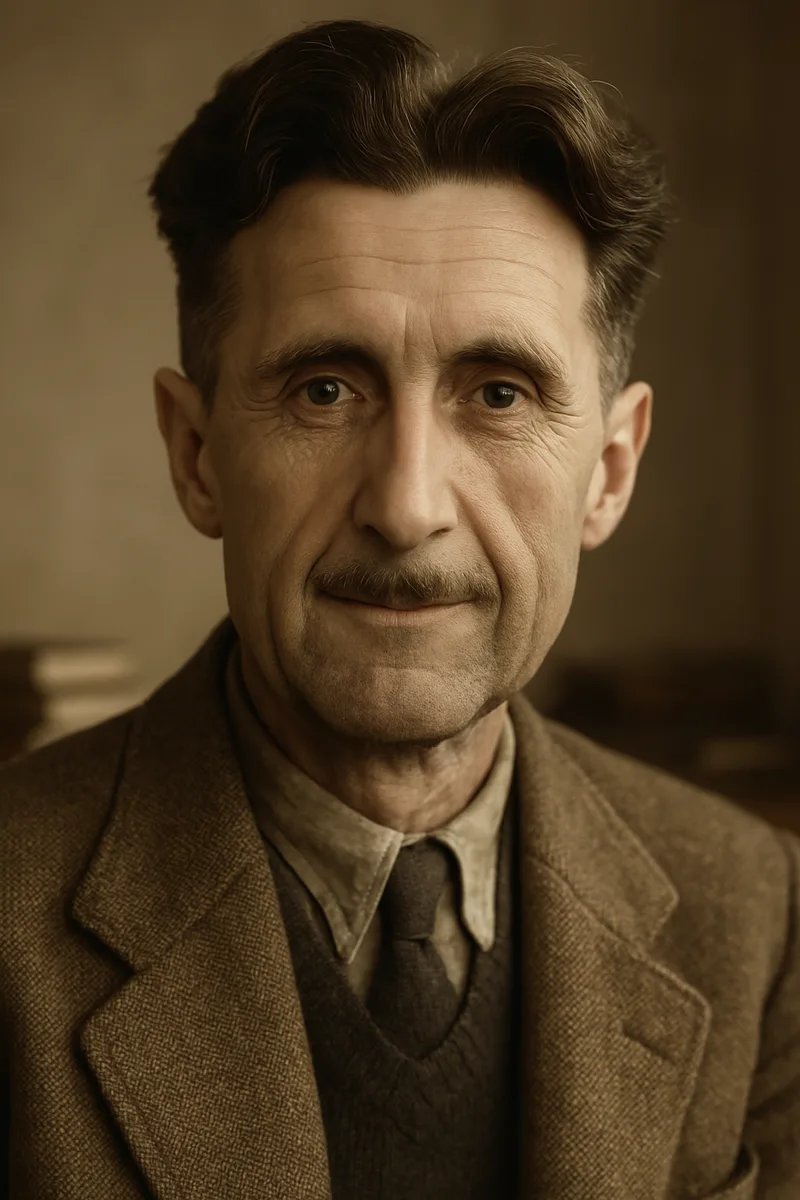
George Orwell: The Conscience of a Century
George Orwell was the most clear-eyed political writer of the twentieth century, a man who used the English language as a weapon against tyranny, propaganda, and self-deception. Born Eric Arthur Blair in India in 1903, he served as a colonial policeman in Burma, fought in the Spanish Civil War, and spent years in deliberate poverty before producing the two masterworks that made him immortal: Animal Farm (1945) and Nineteen Eighty-Four (1949). His essays on politics, language, and truth - particularly "Politics and the English Language" - remain essential reading for anyone who cares about honest writing and clear thinking. Orwell died of tuberculosis in 1950 at forty-six, but his warnings about totalitarianism, surveillance, and the corruption of language are more relevant than ever.
Context & Background
Eric Arthur Blair was born on June 25, 1903, in Motihari, Bengal, in British India, where his father worked as a civil servant in the Opium Department of the Indian Civil Service. The family was what Orwell later described as "lower-upper-middle class" - genteel but not wealthy, maintaining social pretensions on inadequate income. His mother brought him to England as an infant, and he was educated at St. Cyprian's preparatory school (which he later savaged in the essay "Such, Such Were the Joys") and then Eton College, where he was a scholarship student among the sons of the wealthy.
Rather than attend university, Blair joined the Indian Imperial Police in Burma in 1922. Five years as a colonial policeman gave him an intimate knowledge of imperialism's cruelty and absurdity - experiences he drew on in his novel Burmese Days and the essays "Shooting an Elephant" and "A Hanging." He returned to England in 1927, resigned from the police, and embarked on a period of deliberate self-immersion in poverty, living among tramps in London and Paris, which produced Down and Out in Paris and London (1933) - the first book published under his pen name, George Orwell.
The 1930s were the crucible that shaped Orwell's political thinking. The rise of fascism in Europe, the Great Depression, the Spanish Civil War, and the growing influence of Soviet communism forced intellectuals to choose sides. Orwell chose democratic socialism - a commitment to equality and justice combined with a fierce hostility to totalitarianism of both the left and the right.
Orwell went to Spain in December 1936 to fight against Franco's fascist rebellion, joining the POUM militia (a small anti-Stalinist socialist party) on the Aragon front. He was shot through the throat by a sniper - the bullet barely missed his carotid artery - and then, while recovering, witnessed the Soviet-backed suppression of the POUM and other non-Stalinist leftist groups in Barcelona. Communist secret police arrested and killed his comrades; he and his wife Eileen barely escaped Spain alive.
This experience - of being hunted by people who claimed to be his allies - inoculated Orwell permanently against Soviet communism and all forms of authoritarian socialism. Homage to Catalonia (1938), his account of the Spanish war, was one of the first honest descriptions of Stalinist methods in the West. It sold poorly in his lifetime but is now recognized as a masterpiece.
Animal Farm (1945) is a satirical fable in which the animals of Manor Farm overthrow their human master and establish a republic, only to see it degenerate into a tyranny worse than the original under the pigs' leadership. It is a thinly veiled allegory of the Russian Revolution and the rise of Stalin, but its genius lies in its universality - it is a parable about the corruption of power that applies to any revolution.
Nineteen Eighty-Four (1949), written while Orwell was dying of tuberculosis on the Scottish island of Jura, is the definitive portrait of totalitarian society. Its concepts - Big Brother, the Thought Police, Newspeak, doublethink, "War is Peace, Freedom is Slavery, Ignorance is Strength" - have entered the language and become the standard vocabulary for discussing surveillance, propaganda, and the manipulation of truth.
Orwell was six feet two inches tall, thin, and ungainly, with a distinctive voice damaged by the bullet wound in Spain. He was an avid gardener who kept goats and chickens at his home in Hertfordshire and on Jura. He made a list of writers and intellectuals he considered sympathetic to Soviet communism, which he gave to a friend in the Foreign Office - a controversial act that continues to spark debate. He was a passionate fisherman and a lover of English countryside traditions. His essay "A Nice Cup of Tea" (1946), which details his eleven rules for making the perfect cup of tea, is a masterpiece of the personal essay form. He married Sonia Brownell on his deathbed in 1950 and died three months later, on January 21, 1950, in University College Hospital, London. He requested to be buried according to the rites of the Church of England, despite being an avowed atheist - a final Orwellian contradiction.