
Catherine the Great
Quotes & Wisdom
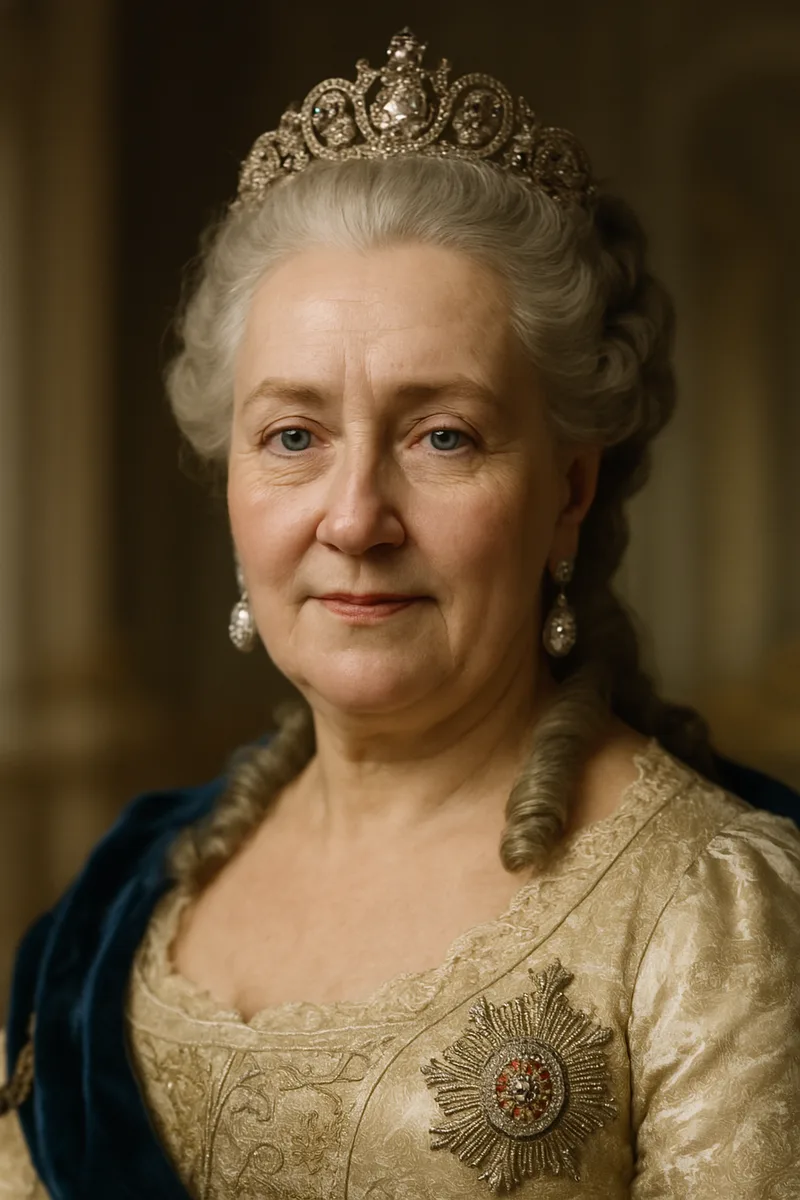
Catherine the Great: The Enlightened Empress Who Transformed Russia
Catherine II ruled Russia for thirty-four years, transforming it from a backward autocracy into a major European power with pretensions to Enlightenment ideals. Born a minor German princess in 1729, she married the heir to the Russian throne, overthrew him in a coup, and governed with a combination of intellectual sophistication and ruthless pragmatism. She corresponded with Voltaire and Diderot, reformed Russian law, expanded the empire's borders to include Crimea and parts of Poland, and built the Hermitage collection into one of the world's great art museums. Her reign was a study in contradictions - Enlightenment rhetoric alongside serfdom, cultural refinement alongside political violence.
Context & Background
Catherine was born Sophie Friederike Auguste von Anhalt-Zerbst on May 2, 1729, in Stettin, Prussia (now Szczecin, Poland). Her father was a minor German prince serving as a Prussian military governor; her mother was ambitious and well-connected. The small German principalities of the eighteenth century were breeding grounds for European royal marriages - minor princes and princesses were matched with more powerful dynasties to cement alliances. When Empress Elizabeth of Russia selected Sophie as the bride for her nephew and heir, Peter, the fourteen-year-old girl was thrust into the magnificent, dangerous world of the Russian court.
Russia in the mid-eighteenth century was a peculiar hybrid. Peter the Great had forcibly modernized the country's military and bureaucracy in the early 1700s, building Saint Petersburg as a window onto Europe. But beneath the Westernized surface, Russia remained a feudal society where millions of serfs were bound to the land and to their masters. The court was a hotbed of intrigue, where factions competed for the sovereign's favor and palace coups were a recurring feature of political life.
Sophie converted to Russian Orthodoxy, took the name Catherine, and married Peter in 1745. The marriage was unhappy - Peter was immature, possibly impotent, and obsessed with toy soldiers and his German heritage. Catherine educated herself voraciously, reading Montesquieu, Voltaire, and Tacitus, and cultivated allies among the Russian nobility and military. When Peter became Tsar Peter III in 1762 and immediately alienated the Russian Orthodox Church, the military, and the nobility, Catherine seized power in a bloodless coup. Peter died under mysterious circumstances shortly afterward.
Catherine embraced the ideas of the European Enlightenment more enthusiastically than any other ruler of her era. She composed the Nakaz (Instruction) - a document of over 500 articles drawing on Montesquieu and Beccaria to guide legal reform - and convened a Legislative Commission to modernize Russian law. She reformed provincial administration, established schools, promoted vaccination (being among the first to be inoculated against smallpox), and encouraged the development of a Russian literary culture.
Yet the fundamental contradiction of her reign was inescapable: she championed liberty in theory while presiding over the expansion of serfdom in practice. The Pugachev Rebellion of 1773-75 - a massive peasant uprising that shook the empire - hardened her authoritarian instincts and led her to grant the nobility even greater control over their serfs. She was an Enlightenment intellectual who governed a society fundamentally at odds with Enlightenment principles.
Catherine was one of the most successful military expansionists of the eighteenth century. Her wars against the Ottoman Empire secured Crimea and access to the Black Sea. She participated in the three partitions of Poland, absorbing vast territories and effectively erasing Poland from the map of Europe. She encouraged the colonization of the southern steppes, founding cities like Odessa and Sevastopol.
Her foreign policy was driven by the conviction that Russia's security and greatness required warm-water ports and defensible borders. The annexation of Crimea in 1783 gave Russia naval access to the Mediterranean through the Black Sea - a strategic achievement with consequences that echo to the present day.
Catherine amassed one of the world's greatest art collections, which became the foundation of the Hermitage Museum in Saint Petersburg. She was a prolific writer, producing memoirs, comedies, operas, and over ten thousand letters. Her correspondence with Voltaire and Diderot was both genuinely intellectual and politically strategic - she understood that association with the great philosophes burnished her image across Europe. She had numerous lovers throughout her life, many of whom she rewarded with estates and titles, though the scandalous stories that circulated after her death were largely fabricated by political enemies. She died of a stroke on November 17, 1796, having ruled for thirty-four years - the longest-reigning female ruler in Russian history.